Thai language schools in Bangkok compared
Search for a Thai school in Bangkok and you’ll find dozens. Most promise “fast, fun, practical” lessons and visa help, and most are near a BTS station. It’s hard to tell them apart.
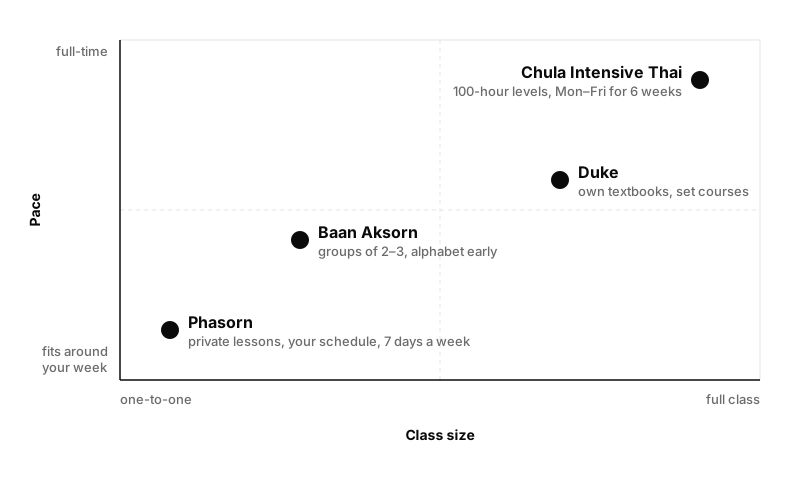
So start with a different question: how do you want to be taught? One-to-one with your own teacher? In a tiny group? In a class with a textbook? Or full-time, at a university? Each of the four schools below is a good answer to one of those questions.
Duke: a textbook course in a group
Duke Language School is on the third floor of the Trendy Building, Sukhumvit Soi 13, about five minutes’ walk from Nana BTS. It’s the most conventional of the four. You work through Duke’s own illustrated textbooks, in courses called Journey 1–3 and then Explore 1–2, with speaking practice, vocabulary and reading in each.
There are intensive morning and afternoon classes, evening and weekend classes, private lessons and online classes. Duke offers ED visas for 8 or 14 months, and you can sign up for a free lesson on its website.
It suits people who like a clear syllabus, a book to take home and classmates at the same level.
Phasorn: private lessons that fit your week
Phasorn is on the 15th floor of Central Tower at Central World, linked to Chit Lom BTS by the skywalk. It’s open from 9am to 8pm, seven days a week, and its strength is private lessons.
You get the same teacher every time and a schedule that fits around work. Lessons are shaped around what you need, whether that’s small talk with your in-laws, Thai for meetings or reading menus. If one-to-one feels like too much, there are semi-private lessons for you and one or two friends, as well as group classes. You can also learn online, or have the teacher come to your home or office. Phasorn offers a student visa course as well.
It suits busy people, shy speakers and anyone with a specific goal. In a group class you might speak for five minutes in an hour. In a private lesson you speak for most of it.
Chula: the full-time intensive
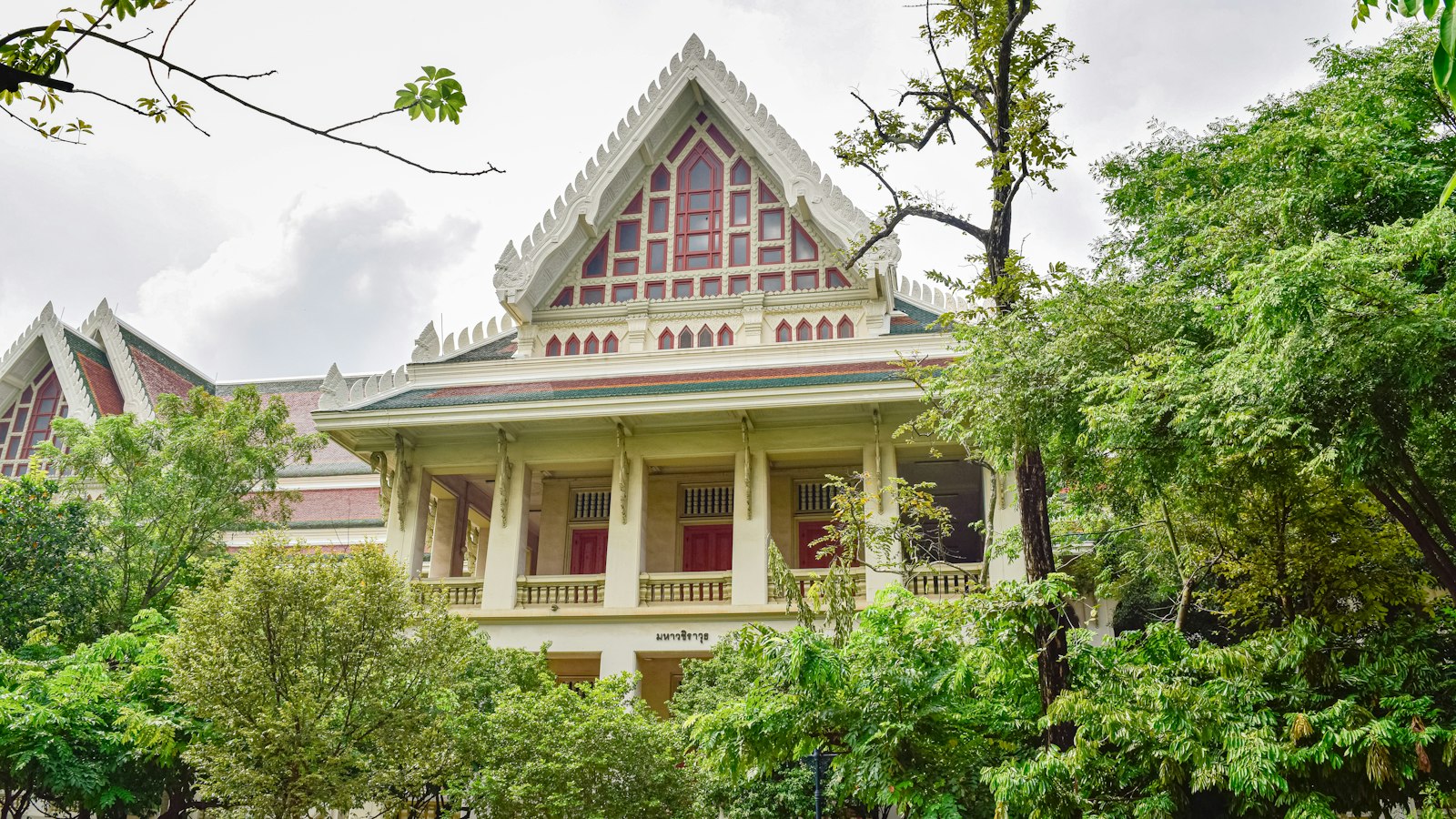
The Intensive Thai Program at Chulalongkorn University’s Faculty of Arts is the most academic option. Each level is 100 hours: 90 hours of class, Monday to Friday for six weeks, plus 10 hours of language and culture activities. It costs 29,500 baht per level, or 23,000 baht online. There are six intakes a year.
That’s roughly 295 baht an hour for a structured university course with reading and writing from the first level, and a certificate at the end. Chula gives you an admission letter if you need one, but it doesn’t handle the visa for you.
It suits people who can study full-time for a few months and want to read and write properly.
Baan Aksorn: small groups in an old Thai house
Baan Aksorn is in a renovated 50-year-old Thai house with a shady garden on Sukhumvit Soi 33. The name fits. บ้านอักษร (bâan àk-sǒn) means “house of letters”, and the school puts the Thai alphabet at the centre early on.
Group classes are tiny, usually two or three students at the same level, and the school is happy to teach one-to-one. Beginner materials use Thai script alongside romanisation and English. Later levels move on to the school’s own graded readers and then Thai newspaper articles. Baan Aksorn offers an ED visa with its year-long programme, which you extend every 90 days with paperwork from the school.
It suits people who want to read Thai, like a calm place to learn and would rather sit with two classmates than twenty.
The ED visa question
Many people choose a school for the visa rather than the teaching. An ED visa (วีซ่านักเรียน, wii-sâa nák-rian, “student visa”) lets you stay while you study, but you’re expected to attend, and the rules change. Before you sign up, ask each school:
- How many hours a week do I have to attend?
- What’s included: tuition, visa paperwork, extension fees?
- Can I switch between morning and evening classes?
- What happens to my money if the visa is refused?
There’s a full post on the ED visa coming soon.
How to choose
Take a trial lesson. Most schools offer one, and Duke’s is free. Afterwards, ask yourself a simple question: did I spend that hour listening to Thai, or listening to English about Thai?
Whichever school you choose, its classes are a small part of the Thai you’ll hear. Classroom Thai is slow and clear. The Thai at the market is พูดเร็ว (phûut reo): fast. When you ask พูดช้า ๆ หน่อยได้ไหมครับ (phûut cháa-cháa nòi dâi mǎi khráp, “could you speak a bit slower?”), people will, for a sentence or two.
So pair your school with listening to real conversation outside class. That’s what Khui is for: everyday Thai at normal speed, with a transcript and a slow-down button for when you need them.